
| < Pieces of the Puzzle from the People of the Planet | Up | Tranquility > |
The Children Came Forth
Modified Photography by Blake Heitzman
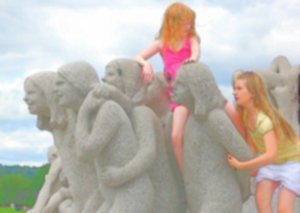
And the Children Came Forth
By Susan Condeff
In shadows great
In shadows small
In happiness, joy
In wonder
In surprise
And they brought forth
Curiosity
Innocence
Imagination
Abandonment
Willingness
The came in the yellow of summer
And played
Played
Till the blue of winter
They became unseen
Eclipsed by youth
Cloaked in years passing
They played too long
And when they left
They left behind
Their skin of childness
Children of Stone
By W. Blake Heitzman
In times so ancient that only the gods and troubadours know about them, in a place north past Bergen, which was not there at the time, north through the archipelago of islands so many and so small that it’s clear the gods put them there to confuse sailors, and then into Sognefjord past Balestrand to where Vik now stands, you must go. From there proceed on foot, straight up the valley, past the stone church built in 1100, past the wood stave church, black and menacing in the mist, wings spread to the ground, carved dragons protruding from every eve, surely once a Viking lodge, but even it was not there then. Go further up the valley, high, high to its source in the granite outcrops that touch the sky.
Look there for remnants of stone walls, and you will find where the hamlet, Nigard, once stood. Beautiful, but harsh in its isolation, to survive its people stood united in all things. In the day they toiled together. At dusk, they gathered in their longhouse and supped and drank mead. They danced and joked and played instruments until the valley itself sang with delight.
One day, Loki, sulking in the form of a vulture, flew over and saw the people bent and sweating in the field. Amazed that he heard not one complaint, he flew closer to hear them laugh and joke amid the strain of their labor.
“Profane is such lightheartedness in this harsh place,” he said, and sat himself on the ground. At nightfall he became a wolf and trotted to Nigard’s wall hoping to hear anger and discord boil up from the aches of the day’s labors.
Instead, there was merrymaking. He was so furious that he shifted from wolf to man to buzzard and back again, over and over, out of control and trembling with rage.
“I will fix them,” he swore, and he set out to do his mischief.
When all was quiet, he slipped over the wall and cut the throat of Henderson’s goat, then he dragged it to Johansson’s door step and ate it there.
On the morrow, Henderson saw the trail of blood and told his wife Sara, “I shall cut the throat of Johansson’s cow for this.”
“No, my husband, for how this evil came, we know not. Let me speak with Olga Johansson and see what she says.”
When all was done, Thor Johansson brought a calf to Eric Henderson and said, “The cause of your misfortune I know not, but I have been blessed with twin calves. Please take one to help you in your loss.”
That night all laughed and danced and played music louder than ever before. Loki was furious and loped off howling and snarling.
“I will get them! I will get them,” he shouted at the moon. Again, in the quiet of the night, he went into the village where he stole the grain from Rasmussen. This he poured near the barn of Lindstrom.
But Astrid Rasmussen spoke to Edda Lindstrom and all was settled, those who had, gave to those who lost, and at night they all ate and rejoiced.
Damn them! Damn them, oh damn them, Loki thought and then cursed them with the vilest of his magic, “May all their women be barren.”
For ten years, no children’s voices, or their laughs or their cries were heard in Nigard. The village went sour. They shared their labors; they had to, but their glee was no more.
Then one day Hans Lindstrom, a stone cutter, called them all together and said, “The gods have cursed us and made us barren. That is clear.
“I have thought long about our pain, and wondered what I, a simple stoneworker, might do to lessen it. I decided that, henceforth, I will forgo dinner each evening and work my chisel on yon granite cliffs to carve the figures of our children not born. Then each morning, we can see their faces laughing in the sun at first light. Maybe this can give us back some portion of the love we have lost.”
All were silent. Mouths hung open in dismay. Johansson looked to Rasmussen. Henderson frowned at Dager. Everyone looked from face to face.
Then Sara said, “I will tend your garden so that you can go in the day and not miss your dinner.”
Thor said, “I will chop your wood for winter so you can spend more time on the cliffs.”
Olga said, “I will milk your cow.”
Every person volunteered to do something so that Hans could work from sunrise until dinner carving the images of their children at play.
Thereafter, the villagers gathered in the morning and as the sunrays hit the cliffs they would point and smile. Edda would say, “Oh look, there is my daughter Inga.”
“Oh yes there she is laughing with my girl, Freda,” Astrid would answer.
“There is Bjorn wrestling with Knut,” Eric would say to Haldor.
And on and on it went with each family naming and claiming a stone child. From this small joy, laugher and song returned to their dinner time.
One day Odin was hunting in the woods below Nigard. In the evening, he rested against a tree and listened to the distant merriment, and he decided to go up and join them.
In the form of a traveler, he came to their gate and called out, “Could you abide a weary soul for the night?”
“Yes, stranger, come and sup with us. Drink with us and hear our story for few travelers come our way.”
So he ate and drank and sang, but he saw no youngsters and knew in his heart that the evil one had cursed them.
“How,” he asked, “is it you have no children, yet you still love life?”
“Oh but we do have children. They are carved in the stone on yon ridge. You will see when the sun strikes their faces in the morning.”
“Aye,” he said, “We shall see all see our children’s faces at first light.” Then he went to his bed.
Eric and Hans and some others lingered after.
“What does he mean “our” children?”
“Maybe he intends to make his home among us.”
“Very good, he is a likeable fellow,” Hans said and they all agreed.
At first light they all gathered, Odin among them. Men came one by one and shook his hand. Some slapped his back in friendly fashion. Ladies came and hugged him. Lingering long were the single ones.
First light shot up the valley and struck the granite. All turned to see. Their eyes found not the gray of stone but reds, yellows, and blues, red hair and blonde hair and dark hair. Voices floated on the air like the songs of birds, and the children came running down the hill, calling to the parents who had named them.
Odin? In the excitement, he vanished. However, it is claimed that from then on, each time a child was born in Nigard, a wayfarer would come and celebrate with them.