
Old Woman at Luoyang Caves in Luoyang, China – 1980
Photography by Annete Langer
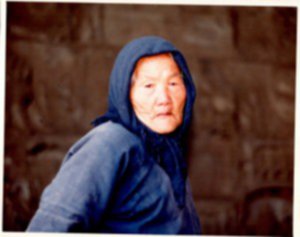
Old Woman At Luoyang Caves
By Paula Chinick
Craggy faced woman
Beguiling, she turns my way
Her warm eyes melt me
Woman of the Cave
Neva J. Hodges
You see me now old,
wrinkled,
with sunken cheeks,
betrayed by time.
I worked the fields
’till the baby
dropped. Then
wrapped it tight
around my back.
At home,
in the cave,
on the dirt floor,
I built a fire
to cook the soup
made from the produce
of the field.
Another child,
that’s all allowed
by the Powers that
govern, though I
live far away.
The Powers
know me not,
or my children – they
care not. The girl,
a burden, oh, what
must I say?
Imagine, though, my
youth
filled with dreams.
It mattered not what
the village said nor
the Powers that
governed.
Young, my hair
cut straight,
flew in the wind
free to be
I knew not what.
But something more
than my mother,
who had worked
in the fields.
The Ancients of Luòyáng
Annette Langer
While in the PeoplesRepublic of China, I visited the ancient Longmen Grottoes in Hénán province in east central China near the city of Luòyáng. The Grottoes, also called the LuòyángCaves, were excavated from the limestone cliffs of the Xianshan and Longmenshan Hills bordering the Yi River which flows between them.
Some of the finest examples of Chinese Buddhist art are found here. The site is home to over fifty carved stone Buddhist pagodas as well as some 100,000 stone statues of Buddha and his disciples found throughout the 1,400 caves. These caves had been excavated over a period of more than 625 years from as early as 500AD, spanning several dynasties.
An imposing fifty-seven-foot high Buddha flanked by slightly lesser statues dominated the main entrance to the Longmen Grottoes. As I explored some of the caves, I saw various chambers containing numerous Buddha statues placed in individual niches. Some were at eye level while others were set in alcoves higher up. An unfathomable number of Buddha statues were carved into the limestone walls, as well, serving as a backdrop for the larger statuary.
In the Cave of 10,000 Buddhas, two-inch-high stone figures of Buddha posed side by side in an endless, repetitive pattern of carved images decorating the cave walls from ceiling to floor.
Additional Buddha statues adorned the walls of the LotusCave. But it was the ceiling that fascinated me. It was completely covered in lotus flower carvings of varying size. Buddhists honor the lotus as the symbol of detachment and purity of the body, speech, and mind.
Although rooted in the mud, lotus flowers blossom on long stalks as if floating above the muddy waters [of attachment and desire].
The Longmen Grottoes covered more than a half-mile stretch of land along both banks of the Yi River. Most of the grottoes were on the western bank of the river while the smaller number of eastern bank caves served as residences for large groups of monks.
I walked along the pathway from cave to cave, carefully picking my way over the uneven ground as I took in the sheer magnitude of the site. Every so often, I’d scan the panorama through my camera’s viewfinder, snapping one photo after another while silently marveling over the artistic creativity displayed within the grottoes.
Then my eyes rested on her. It was an old woman of an impossibly indeterminate age. I studied her features from behind the refuge of my high-power telephoto lens. I was so far away from her—on the other side of one of the caves, in fact—but I saw her clearly nevertheless.
She had no idea I was looking at her and not at the incredible statues. The old woman was striking, and I was captivated by her. Dressed from head to toe in dark, drab blue—the uniform clothing of every Chinese adult at that time, male and female alike—she should have blended right in. But against the dark blue of her clothing, against the shadowy background of the ancient caves, her face had fairly shown. It glowed in the early morning light as if the golden light had radiated from her.
What kind of life had she had? I wondered. Had she toiled hard her whole life and made many sacrifices? Did she have a family who loved her? Was she someone’s grandma? Or great-grandma, perhaps? Why was she here alone?
I imagined her alongside other women in the fields, seated on a small wooden stool as she bent over her work, planting seedlings. I’d seen women of all ages in the communes I’d visited planting in the fields there. Some were just young girls but others were much older, like her.
I pictured her kneeling beside a stream, perhaps the nearby Yi River, quietly dipping her clothes into the water to wash them. I wondered if she daydreamed as she worked and if so, what sort of thoughts occupied her mind as she scrubbed the grime from her laundry.
The old woman stood in the dim light of the limestone caves, stooped over as if the years had bent her like a tree punished repeatedly by strong winds. I couldn’t tell from her calm expression if she might be sad or just weary. Her mouth turned downward, not in a frown, but just burdened from the gravity of her years. Each crease, each wrinkle seemed to weigh down her face. She looked so fragile, so frail, and yet strong and resolved. Beyond that, a kind of serenity embraced her, an almost peaceful appearance. I wanted to give her a hug.
I wished I could approach her and speak to her but knew that was not possible. We may as well have been on two different continents, the barriers of both custom and language the ocean that separated us. But that didn’t lessen the impact she’d had on me.
The Longmen Grottoes were spectacular indeed, rich in history and abundant in cultural treasures. But no less moving was the history and the mystery which inhabited the face of that old woman. She, like the Longmen Grottoes, was one of the ancients I had discovered at the Luòyáng Caves that day, and was just as precious to behold.
By Patricia Boyle
You ask for my story? It is your story too. We are not so different as you think. I have lived, and loved, and lost. I have laughed with joy and wept in grief. My husband was a good man. We were wed for fifty years. He is gone now. Also my son, dead of a burning fever. My daughter-in-law, she is good to me. We bring comfort to each other.
I am plain, wrinkled, a simple person. It is true. My life has been a hard one, perhaps harder than yours. There have been more tears than laughter, but I have known both. I do not have the comforts you have known; my story is not hidden under smooth skin and a painted face. My life’s story was etched into my face over time like the carvings in the cave walls. I have lived long years. I am ancient. I am hard like the stone of these caves. I am strong.
You do not think we are alike? Do not be mistaken; we are more alike than we are different. We are but one human family. You are flesh of my flesh, bone of my bone. Stripped of your warm home, your fine clothes, your fancy cars and elegant restaurants you are much like me. Underneath it all, you are much like me. We live, we love, we lose, and we carry on. My face is your reflection. Your story is etched in your heart.
Be strong, my child.
Old Woman of Luoyang
By Lynne Fix
I am an ethnic minority of Luoyang China, the region considered the “cradle of Chinese civilization.” I work to preserve the heritage of my homeland; a land that embodies centuries of Chinese culture and folklore.
Every year I see millions of visitors of passing through on their way to visit the historic relics of my culture. They scamper from site to site as if they are trying to see the last performance before the stage darkens. Yet, the landmarks have been here thousands of years and will not disappear overnight.
If I could communicate with you, I would tell you about the history of my ancestors. Ah , the stories I could tell. My home, Luoyang which is famous as the ancient capital of nine dynasties and the historical birthplace of the ancient silk road. Today processions of tourist buses, taxi lines and SUV’s have replaced the caravans of old.
Visitors often stop at the white Horse Temple (BaimaTemple) located just east of the city. It is an old temple dating back to 68 AD and often considered the first Buddhist temple built by officials in Chinese history. Folklore has it that Emperor Ming had a dream about Buddhism and then sent monks to study in India. When they returned with replicas of the Buddhist scriptures, they were celebrated with a temple honoring the horses that had helped them complete the mission. Today, it is one of the most interesting temples in northern China and still houses Buddhist monks, both male and female.
Another nearby landmark bolstering the tourism trade is ShaolinTemple, which is located in the heart of Shaoshi Mountain. Often touted as the “FirstTemple in the World,” Shaolin a temple is widely regarded as the mecca of kungfu practioners and martial arts aficionados.
What is not usually understood is that it is not the original monastery; the grounds have been destroyed and rebuilt several times. In the 14th century, bandits sacked the monastery for its treasures and the monastery was abandoned. When the monastery was rebuilt the monks decided to protect themselves in strategic hill bunkers and developed the art of battle and self-defense which is sometimes referred to as Chinese kung fu. Nowadays, the grounds and martial arts training in ShaolinTemple has become modernized and commercialized with celebrities and even Russian President Vladimir Putin dropping by to discover their inner Zen. Not infrequently, strangers can walk up to the entrance, ask for admission and receive a month of kung fu training and Zen meditation. Also the ancient ceremony of jieba, or burning of incense into the scalp is no longer practiced. When I see the hordes of tourists and video game junkies searching for the origins of Bruce Lee legend, I feel that maybe the heart and authenticity of the ancient tradition has been maligned.
One of my uncles, who came from a particularly poor family, spent years at Shaolin, not because he was a kung fu practioner but because his family was too poor to pay for his education and upbringing. He spent about five years exercising and meditating at the temple in a time when China was very poor. Even to this day, he refuses to visit the place because it brings back bad memories. As is everything in China, economic growth and commercialization seems to muddle and confuse the past.
A place where I like to spend my walking time is one of the World Cultural Heritages, Longmen Grottoes. It is a large scenic mountain area that borders the sides of the Yi River and covers miles of caves and wall side carvings of ancient China Buddhism Sculpture Art.
The grottoes were carved during the Northern Wei Dynasty and continued through the Eastern and Western Wei, Northern Qi, Sui, Tang and Song Dynasties. There are more than 2,345 grottoes, 2,680 stone tablets and inscriptions with the biggest one measuring about 17.14 meters.
When visitors come by they usually take photos and stop at the entrance monument which reminds them of the value of cultural heritage and its national roots. Their faces drop when they realize that hundreds of the heads of the carvings of the Longmen Grottoes are missing or have been destroyed. There was a time in Chinese history when bandits and art relic collectors came and took many of the Buddhist pieces and the Chinese Government has spent considerable time to locate and purchase the missing head pieces. So in a way, the Longmen Grottoes tell a historical tale of China and its history through the art pieces on display and by their absence.
Crowds from all over the world flock to Luoyang historical sites which showcase the magnificent relics, murals, carvings and heritage of China. On their quest to photo capture China, they often drive by the carriers of culture; the ethnic minorities that occupy the region and can tell the cultural story of bygone days. If they could communicate, they could tell you about the people who built and carved these relics, the generations who have worked to preserve and safe keep the national treasures and traditions that have been passed on for centuries.
Today, I walk the trails at Luoyang at age 82 because I want to let visitors know, there is more to the area than tourist centers, souvenir shops and kung fu performances. I am a walking museum of Luoyang and a living representative of this civilization.