
| < Somewhere Out There | Up | The Abandoned Post > |
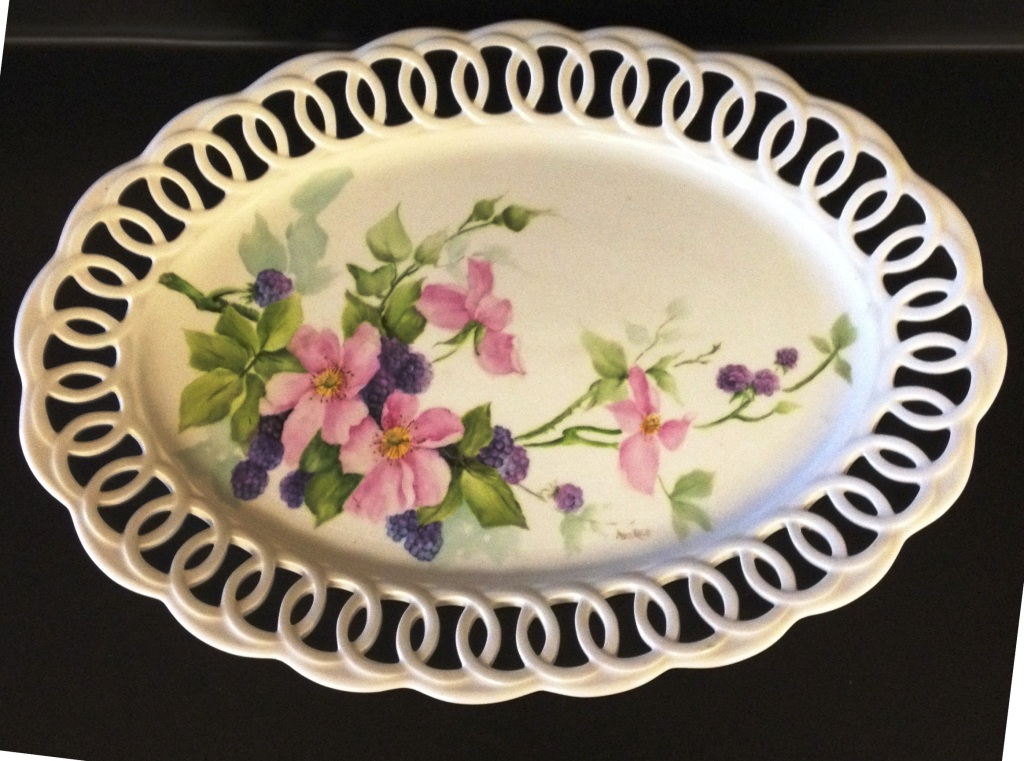
Painted Porcelain
12″ x 16″
Renewal
by Camille DeFer Thompson
Spring opens the door
Sunlight streams in, chases out
Winter’s gloom. Joyous.
Come Home in Spring
by Julaina Kleist-Corwin
They don’t come for Christmas.
Too much snow,
Flights are late, cancelled, slow.
Wait for spring.
Long months to be alone
What to do
Clean clutter, dust, polish
Count each dish.
Mother’s painted platter,
Our anchor
Delicate flowers made
For table grace
And memories replayed.
They arrive on time,
Children grown,
Sweet babies of their own
Spend hours
With family flowers.
Spring Cometh
by Jordan Bernal
Snow melts with the sun
Pink and purple flowers bloom
Spring abounds once again
Beauty
by Diane Lovitt
Berries, leaves, petals
Reach across the porcelain plate
Making me smile too
Reflection of Anne’s Art
by Elaine Schmitz
Buds, blossoms, berries across a plate pure white
Are harbingers of spring days bright.
Cut-through patterns edge the dish,
Remind me of a garden gate I wish
To enter, to bask in genteel sunlight.
The piece itself appears fragile,
As delicate fine china will,
Yet fresh blooms that may shake
In cool vernal breezes can make
One watching strive to keep all tranquil.
Friendships can be like spring,
Making hearts and new thoughts sing,
With elegant prospects to glean
And new vistas to be seen,
When allied minds join in sharing.
The Breath of Spring
by Patricia Boyle
Jill surveyed the pile of boxes waiting to be unpacked. Even though her marriage had been a disaster, a mantle of gloom had settled over her when she’d told Mark she was leaving him, tired of his cheating and lies. The melancholy mood clung to her still. She’d fled Manhattan for a simpler life in western Massachusetts, unprepared for the loneliness that filled her days.
She shivered as a brisk wind rattled the bare branches of a red maple in the front yard. The winter landscape looked chilly and barren. Jill shook her head, dismissing the bleak scene. Grasping the closest box, she used her penknife to slash through the tape that secured the flaps. She had a vague memory that the package contained items Mark disliked, mementos of her life before their marriage. Twelve years ago, when they moved into their new apartment after the wedding, he said, “We’re starting our life together. There’s no room for your old knickknacks.” She’d stuffed everything back inside and put the re-taped box on a shelf in her closet, where it remained until she moved out. Now she wondered if she still cared about the objects it held.
When she removed the top layer of newspaper, she smiled for the first time in weeks. Yes, she cared. She cared very much. Sitting on top of the pile was her grandmother’s porcelain tray. The beautiful, ivory oval was ringed with interlocking circles. The tray sported a leafy blackberry twig, bearing delicate blossoms and berries that looked real enough to eat.
Jill lifted the tray out of the box with gentle hands. The painted image transported her back to her childhood. The sprig summoned up what was, to Jill, the most exhilarating scent that existed; the smell of new growth and damp earth. She recalled walking to school in early spring, inhaling the strong odor, while disregarding patches of grimy snow that lingered in shadowy corners. As a child she called the heady scent “the breath of spring,” and made futile attempts to store it in empty jars to savor on the darkest days of winter.
Jill held the tray at arm’s length, smiling once more. The blossoming twig was a promise that spring would come again, and life would be renewed. A thrill of excitement passed through her. She promised herself that not only plants would repeat the cycle, but that she would make the most of her fresh start. Gingerly, she placed the tray on her bureau, ensuring that spring’s promise would be the first sight to greet her each morning.
—The End—
Finding the Center
by Linda Todd
My earliest memory of the berry plate was one Thanksgiving—I must have been about seven. I was helping my grandmother set the table. “This will be good for the bread,” I said while I reached for the plate that always sat on the buffet.
“Kirsten, no, don’t touch that,” Grandma said in a sharp voice she rarely used. She whisked the plate off the buffet and put it on one of the high shelves of the hutch behind glass doors.
I thought I had done something wrong and my chin began to quiver. I tried blinking back the tears from my eyes, but they spilled onto my cheeks.
Grandma pulled me into a hug. She smelled of flour and cinnamon. “Oh, dear. I’m sorry. That’s Grandma’s special plate.” She broke the hug and knelt down at my level, her hands on my shoulders. She looked me square in the face. “We don’t use it for food.”
“What’s so special about it?”
“It helps me find my center.” Grandma wiped the tears from my face with the hem of her apron and then the timer in the kitchen sounded. “Come on it’s time to take the pumpkin pie out.
I didn’t know what she meant about finding her center. All a person had to do was put their hands on their belly. I thought maybe she was catching the Alzheimer’s like Grandpa did.
I never really thought about the plate much after that Thanksgiving dinner. It was just another knick-knack that graced Grandma’s house.
About eight years later Grandpa died. At their house after the funeral, Grandma stood with her perfect posture and poise as she greeted neighbors, distant relatives, and friends. They expressed their condolences with hugs, handshakes, and kisses on Grandma’s cheeks. Flowers graced every available table surface throughout the house. Their sweet smell perfumed the air, overpowering the aroma of fried chicken, casseroles, and spinach dip.
After the guests had left, my mother and I cleaned up and Grandma disappeared into her bedroom. While moving flower pots off the buffet, I wondered where the plate had gone. I found it on the same shelf Grandma had placed it when she didn’t want to use it for the bread that long ago Thanksgiving. I put it back on the buffet.
“Well, I think that does it,” Mom said while she hung the blue checked apron on the back of the pantry door. “You sure you’ll be okay with Grandma on your own?”
“Yes, we’ll be fine.” Mom kissed me on the cheek and we hugged each other while
A few minutes after Mom left, Grandma came downstairs. She proceeded to wipe down the kitchen counters that Mom had just cleaned. Then she moved into the living room and straightened the pillows on the sofa I had already plumped and rearranged the magazines I had organized. All the while, she muttered to herself about things that didn’t make any sense to me.
I had to distract her somehow. “I’m going to fix myself some tea, Grandma. Do you want some?”
“I don’t care for any, but thank you dear.”
I went into the kitchen and prepared the tea for her and me. I could hear her shuffling around the house and muttering to herself.
“Come sit with me, Grandma.” I brought our cups of oolong tea and a dish of chocolate chip cookies into the dining room and set her cup so she that she had a clear view of the plate.
Grandma came into the dining room and said, “You really didn’t have to stay. You can go home if you like.”
“No, I’d rather be here with you. In case you need me.”
“I won’t.”
“I know.”
She settled into her chair across from the plate and as if on cue, Grandma’s shoulders relaxed after she reached for the cup of tea and looked in the direction of the plate. It was then I realized what she meant about the plate’s power to center her.
I sit here today across my own dining room table and focus on the berry plate. I feel fortunate that I, like Grandma, have something to remind me of the circle of life, something that symbolizes the promise of renewal, and something that helps me find my center in those times when my world seems out of control.
| < Somewhere Out There | Up | The Abandoned Post> |