
| < Couple: My Love | Up | Evening Bag > |
Painting, Acrylic
18″ x 20″
Choo Choo Surprise
by Kathleen Kull Urban
Engine roaring
Down the track
Huffing, puffing
Clack, clack, clack.
Children watching
By the side
Hoping they can
Catch a ride.
Train starts slowing
Then they see
Heads poking out
One.. two.. three!
Children dance and
Skip and run
It’s circus time
Oh what fun!
The Old Child Remembers
by Art Tenbrink
I dropped small white pills
Into the Lionel’s stack
And out came the smoke
Train Trip
by Jordan Bernal
Rolling on the track
Traveling through lush valleys
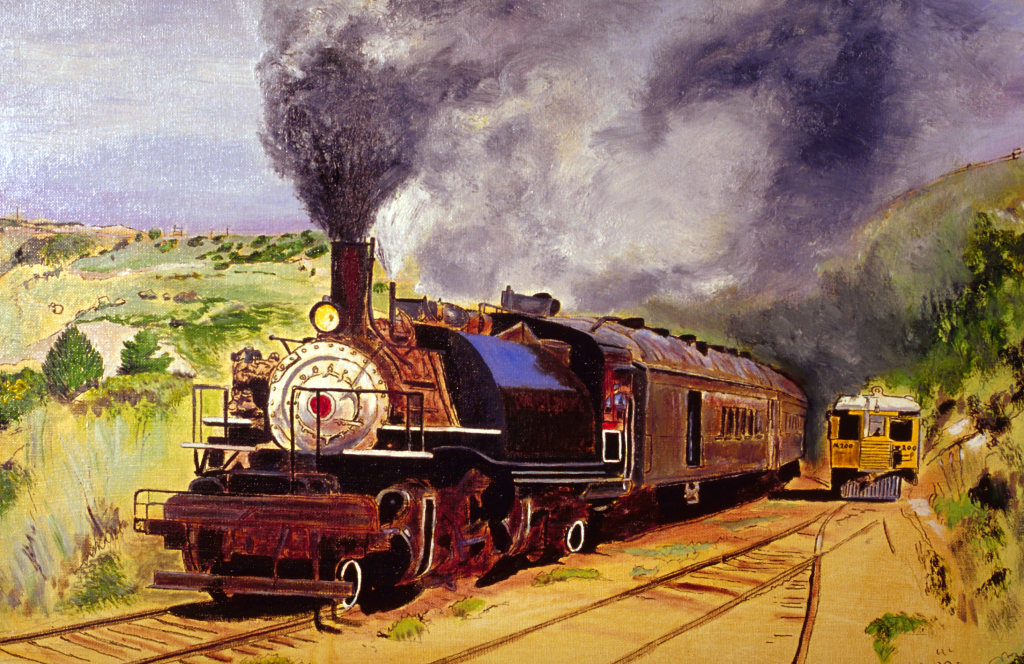
Engine No. 2
Engine No. 2
by Victoria Emmons
Black steam churns and spits
From every crevice of the old maid
Her body worn with travel
Soaked with time and stories to tell
She coughs with every breath
Attempting to please the crowd
Those who decry her age
Love her no matter what
Each chug makes her believe
She can, she can, she can
She thinks she can and she will
Fly down the rails yet again
Surprise
by Diane Lovitt
The roar and the smoke
Surprised the calm landscape
Until the next time.
Untitled
by Patricia Boyle
hundreds of horses
charge through the valley
belching smoke
The Train Robbery
by Shannon Brown
A smaller yellow train pulled up beside us as we rode, gasps and murmurrs could be heard throughout the car. “Quick Emily”, Pa whispered to me, take this and put it in your shoe. I took the gold pocketwatch and slipped it into my sock, then hastily laced it back up, hoping the bulge wasn’t apparent. I popped back up seconds before a gunshot cracked through the smoky coal scented air.
“All right, Ladies and Gentlemen, we are the Jenkins Brothers, and we mean you no harm. Just kindly place your valuables into this sack and we can be on our way. Mind though, if Emmet here sees any of you neglect to place your item within the confines of this here sack we shall have no recourse but to put our weapons to use.” The speaking brother, who must have been Magnus, waved his gun and pointed it at a scared looking woman in an outdated gingham bonnet. “We’ve no wanting to spill innocent blood so just kindly do as you’re told,” Magnus continued, his voice muffled under the dirt crusted bandana he wore.
The gunnysack passed through a series of shaky hands, as it got closer I could see the faded name of a flour company on the outside. Pa tossed in his wad still encased in the money clip Constable McHenry had presented him with; he had no gun since the train people made us keep our weapons in a separate car. Ma dropped in the locket Pa had given her on their last anniversary. She had no choice. I tried to ignore the single tear streaming down her face.
Outside I swore I heard the rumble of hooves, I sneaked a glance up from my shoes to the windows outside. No it couldn’t be, but it was. A man dressed in a long dusty brown overcoat, jumped from his horse toward the train coupling. I couldn’t tell if he made it, I held my breath until a booming voice, said “Put those weapons down, Magnus and Emmet Jenkins you are under arrest, for robbin, and larceny, and horse thevin, and the cold blooded murder of Phineas McHenry the Third.”
The sheriff stepped forward and as the two thieves pointed their weapons he tripped and rolled forward. Then the lawman popped up with a shit eating grin, behind me a too familiar voice yelled “Cut.”
Groans now filled the train car as the directors told us extras and bit players to resume our places. “The trip is supposed to messy, not acrobatic, and your grin was far too slapstick. We need to do it again.” Jake, the lead actor nodded in agreement, then went off to get his makeup refreshed. Outside I could see the stuntmen remounting their horses. I hoped another assistant would come by with water cups before we started shooting properly, the heat of the train car sure made it feel like the old west to me.
I pulled the pocketwatch from my sock and handed it back to Dad, who was busy playing the racecar app on his phone. Mom was looking at facebook again, seriously how many updates could there have been since the last take? I rocked back in forth in my stiff old-fashioned shoes, Man I couldn’t wait for this film to wrap.
—The End—
Meeting Aunt Clara
by Linda Todd
Engine No. 2 rounded the corner. Its smoke stack spewed black clouds into the air and blocked out the green hills in the distance. The squeal of metal against metal slowed the beast as it approached.
I usually didn’t come to the station with Pa when the train came to town. The billowing soot makes my eyes burn and all the noise makes my ears hurt.
“Today’s a special day,” Pa had said when we woke up. “You’re Aunt Clara is coming to live with us.”
“Why?”
“To take care of you.”
“But you take care of me. And I take care of you.”
“We need a woman in the house again. Someone who can cook and clean and fix your hair proper-like.”
Pa and I had done pretty well together after the consumption took Ma six months ago. Pa worked out in the fields the same as always and I did the chores the best I could. I hadn’t quite mastered Ma’s steak casserole and corn bread yet, but we weren’t starving.
“I cook and clean, tend the garden, and take care of the chickens too. We don’t need anybody. We have each other.”
“Schools starting up again in a few weeks. It’s time you get back to your education.”
“I’ve got the books Miss Margaret lent me. I want to be here, to help you.”
“You’re seven. It’s time you went back to school, be with your friends.”
“No, I won’t go.”
“You’ll do as I say, young lady. Now put on your Sunday dress. We need to leave before daybreak if we’re going to be there when the train arrives.”
During the ride to town, I stared out at the landscape while Pa handled the reigns and we bumped along the dusty road. He tried to get me to talk, sing songs, or play a game, but I pretended I didn’t hear. He stopped as we cleared the hill above town. “You’re gonna like Aunt Clara. She can be like a mother to you.”
“I had a Ma.”
Pa, placed his gloved hand under my chin and turned my head toward him. Water pooled in his eyes the way they did when we grieved for Ma, the way mine did now. “You’re right, pumpkin. No one will ever replace your Ma. Not Aunt Clara, not no one.”
“You can’t make me like her.”
“Just wait until you meet her. Then you can make up your own mind.”
I wiped the tears from my face and said, “Okay.” But I was pretty sure I wasn’t going to like Aunt Clara.
Pa and I held hands while standing on the station platform waiting for the train to stop. The porter jumped down from the passenger car steps and placed a stool on the ground. Men with guns holstered to their hips and men with fancy suits and top hats hurried off the train and scattered in all directions. The porter helped a woman with a valise down from the steps. She had a little boy and girl with her. The girl looked about my age and I wondered if she was coming to live here. Maybe we could be friends.
I gasped as the next passenger stepped off the train. Pa squeezed my hand and said, “There she is.” The lady wore the most beautiful pale blue dress I had ever seen. The over skirt swooped up to one side; leaving soft folds to cascade down exposing the underskirt. Wispy bits of her reddish hair escaped the pins meant to hold them in place, just the way Ma’s used to at the end of the day. On top of her head was a black hat that looked like a baby version of the ones the men in fancy suits wore.
I couldn’t imagine this lady with her pretty dress working around the farm, collecting eggs, or digging in the garden. I looked up at Pa thinking I’d see on his face the mistake he had made. Instead, his lips turned up into a smile and his eyes brightened just like they did before he would wrap his arms around Ma and kiss her.
“Come on, pumpkin. Come meet your Aunt Clara.” Pa pulled me toward the woman who was pointing out her trunks to the porter. “Clara, here we are.”
Clara turned around, “Tom, it’s so good to see you again. And this must be Martha.” Clara knelt down and held out her lace-gloved hand. “It’s a pleasure to meet you Martha.” I shook her hand, but didn’t say anything back. With her skirts pooled around her on the dirt, she opened her bag and pulled out a package wrapped in purple paper and held it out for me. “I thought you’d like to have this.”
I took the package and she helped me unwrap it to reveal a doll with a big white bow clipped to her curly brown hair. “It was your mother’s doll when she was a little girl.”
I held the doll close and noticed her blue eyes and long lashes through the tears that bubbled over onto my cheeks. I looked up at Aunt Clara and saw she had tears running down her cheeks, just like me. “Thank you.”
Aunt Clara hugged me the way I hugged the doll. She smelled a lot like Ma used to. Maybe Aunt Clara will work out okay after all.
—The End—
Train of Thought
by Pat Coyle
This morning, as I sat meditation, the sound of a repeated train whistle brought me up short. The sound of a train whistle almost always brings me a twinge of melancholy, of sadness. I’m not sure why.
It’s fall now and I recall an old song dating back to high school. The idea was that summer was almost done, winter would be arriving soon – the author had stayed too long, it was time to travel on. The song included a lonesome train coming through town – and feelings of having to, wanting to, travel on – homeward bound.
John Bluck’s, Engine No. 2, a painting in acrylic, comes to mind. John submitted it for our California Writers Club TriValley Branch Winterfest Ekphrasis, where members create written works, inspired by visual works of art.
A steam locomotive with eggplant purple boiler, the the cab black, brown, red, pulls a string of rust-brown passenger cars past a siding where a school-bus-orange passenger car faces the other way. The painting evoked feelings of wistfulness, a vague sense of loss. I wondered for a moment, who’s in the car stopped at the siding? Grey-black smoke bellows from the stack as the train emerges from a curve, with hills in the background, in shades of yellow, with green grass and trees.
Thinking of trains evoked Kurt Vonnegut’s lines from his novel, Bluebeard:
“…How I adored that train!
God Almighty Himself must have been hilarious when human beings so mingled iron and water and fire as to make a railroad train!”
Then Vonnegut jumped the rails, cut to modern times:
“Nowadays, of course, everything must be done with plutonium and laser beams…”
My thoughts leaped with him. I remembered working on a Lawrence Livermore Lab project for a plant in Idaho using lasers to enrich plutonium. It was shelved in 1990, when the president decided we had enough weapons-grade plutonium.
His decision to stop the project led to our family relocating to Colorado for a two-year assignment, then to the Washington, DC area for another. We drove. We didn’t take the train.
Later, I thought about this time in my life. I went in my office and pulled a yellow clean-perf wireless notebook off the shelf. The bright yellow was faded near the broken spine. Amongst some loose sheets in the front, I found a classic folded paper airplane. Unfolded, it showed a drawing my son, Scott, had made of me when he was a first or second grader. In it, I was working a calculator with one hand, the other hand on a book titled, The Book Worth Nothing. A tube runs from a Bush Light, labeled, “the new automatic beer bottle shoots out beer for you”, to my toothy grin. At the bottom, he’d printed, “PAT IS COOL!!!”
I turned the paper over and saw that the other side was an input sheet for
plutonium processing equipment modeling software. This sheet was for a nondestructive assay glovebox intended to process items assayed in either a neutron coincidence counter or segmented gamma scanner for accountability purposes. The rest of the sheet was filled with specific details about the process inputs: high and low density solid waste, furnace scrapings, passivated solids, failed in-repair process equipment, molds and crucibles, empty containers. The shared services listed glovebox exhaust and supply nitrogen recycle systems.
Some paper airplane – modern times, my son.
The first entry in the journal was dated 11/29/90: “I’ve been looking at Writing Down the Bones and Keeping Your Personal Journal and toying with making a start. This cheap yellow notebook was my pick from a browsing session in Best’s and a stationary store and finally Target. I fiddled around a lot to pick it. I noticed, with disbelief that that the nice bound record books I use at work are $32 each. I’m thinking of why bother, make the time, what I expect of doing it – and on and on nattering. It appeals to me though so we’ll see.”
The next entry in the journal was dated 12/11/90: “Curious to me that I think of writing but don’t. I’m aware of busy dreams in the last few days…”
My thoughts flashed back to trains. Happy train rides, years before.
In January 1977, Kathy Scott and I were married in Rosetown, Saskatchewan. The next day, we drove to Saskatoon and caught the Canadian National train to Ottawa. Kathy was to be debriefed about her completed assignment with the Canadian International Development Agency (CIDA) project to provide water and sanitation to Belize City. Our accommodation was an old-fashioned, European style coach compartment: the lavatory tucked into the wall and seats that transformed into a bed.
The train stopped in Winnipeg where we got off and walked up Portage Avenue to get a coffee. Big mistake. The wind cut me to the core. I was no stranger to cold, having weathered Wyoming’s 40-below winters, but this felt like the coldest place I’d been in my life.
Back on the train, it was so cold that the heating system began to freeze up and delivered less and less heat until we were finally huddling for warmth, fully dressed, with our coats on, for the first part of our honeymoon. The heat did get fixed and we enjoyed the rest of the 1,400-mile ride, watching the winter scenery: grey, white, sometimes with dazzling blue sky, sometimes with snow flurries that blended sky to ground in whiteout. We passed through remote parts of Canada, some accessible only by ski-plane and train that time of year. We played lots of backgammon and I learned of Canada’s liquor laws which required the porter to carry my beer from the bar car to our compartment.
After Kathy’s meetings we flew commercial back to Saskatoon. From there, we flew our Cessna 172 back through the States and Mexico to Belize, almost 6000 miles. It was so cold, the paint flaked off the rear part of the fuselage when we left Canada. We stopped in McCallan, Texas and got it repainted. While there, our fundamentalist Christian missionary pilot and aircraft mechanic friends tried unsuccessfully to get us to accept Christ as our personal savior. It wasn’t enough for them that we’d just been married in the United Church of Canada.
My thoughts fast-forwarded to another train ride in 1983. Our daughter, Lizzie, was almost one, just starting to walk. We took the Amtrak out of Oakland for Vancouver, going to Calgary.
This was before the Oakland station was remodeled: shabby, faded, art-deco look of the WPA period. Strange, the things we remember. In the men’s room, a coin-operated electric razor glowed with an eerie green light intended to disinfect the razor between uses. I didn’t try it.
This Amtrack train sleeper accommodation was US-style, modern, compact, sleek plastic, lacking the charm of the old European-style coach of our honeymoon trip. We traveled with Lizzie’s plastic bags of Cheerios, her go-to snack. Dropped Cheerios trailed behind us – our toddler wake.
I remember drinking beer in the bar car, watching Lizzie toddle up and down the aisle in her pink pajamas with red hearts. The segment from Seattle to Vancouver was by bus. In Vancouver, at dinner, we looked over and saw Lizzie facedown, fast asleep, in her high chair.
At the Hudson Bay department store, I bought a navy blue bathrobe with cream-white stripes. I regretted having to replace it a few years ago when it was finally too threadbare to hang on a hook in the bathroom.
The Canadian National train left Vancouver late in the evening, moonlight shining on the Fraser River. By dawn, we were well into the Canadian Rockies. The rails wound through switchbacks and curves where we saw the train cars stretching out behind us, the river below, rugged pine-covered mountain slopes rising to the horizon. We saw high peaks, mountain passes, and traveled along rocky lakeshores and ranchlands of the interior. It continued like this through Kamloops, into Banff. From Banff, a bus again, for the last leg into Calgary. I remember, by then, I had a raging cold, a scratchy throat.
That was the last train ride we’ve taken. I’m looking forward to more.
I think of what writing means to me now, why the sound of the train in the
morning evokes a sense of sadness, melancholy, nostalgia – even when it’s not approaching winter.
For what, and why would I write of this, why would I write of John’s image of trains and what they might mean?
John writes science-fiction. What does this train he painted mean to him? Does it matter?
At our December meeting, I spoke to him about this. John spoke about his
painting. In his years at NASA he worked in public affairs, photography and TV programs, including one about former astronaut Alan Bean, who’d resigned from NASA in in the early 1980s to devote his time to painting.
“Bean inspired me to start painting myself,” John said. “Space stuff, but other things as well.”
Afterwards I looked at John’s web site, where I found over two dozen paintings of aerospace and other oil paintings.
“What about the painting of the train, Engine No. 2?”
“A friend of mine who worked on the Niles Canyon Railroad asked me to paint it for them.”
“What does it mean to you,” I asked.
“ I don’t know. Something out of a novel about the old west, maybe, like The Great Train Robbery?”
Even had I not learned of John’s intention with his painting, is it enough just for us to see it and form our own opinion, to take from it what resonates with us, let it serve as a prompt, just as the sound of the train whistle this morning evokes deep, old feelings, not easy to put a name to; and happy memories of other train rides and warm feelings of a life, the start of a marriage, a first child, a second-grade son.
This is an act of mind taking us back, back to what Natalie Goldberg, of Writing Down the Bones, refers to as an old friend from far away, our earlier self, the self we write about in memoir, in personal essay, in trying to understand this character in the story of our lives, of what they want, what their deepest desires are, what desires they don’t yet even know they have.
| < Couple: My Love | Up | Evening Bag > |